
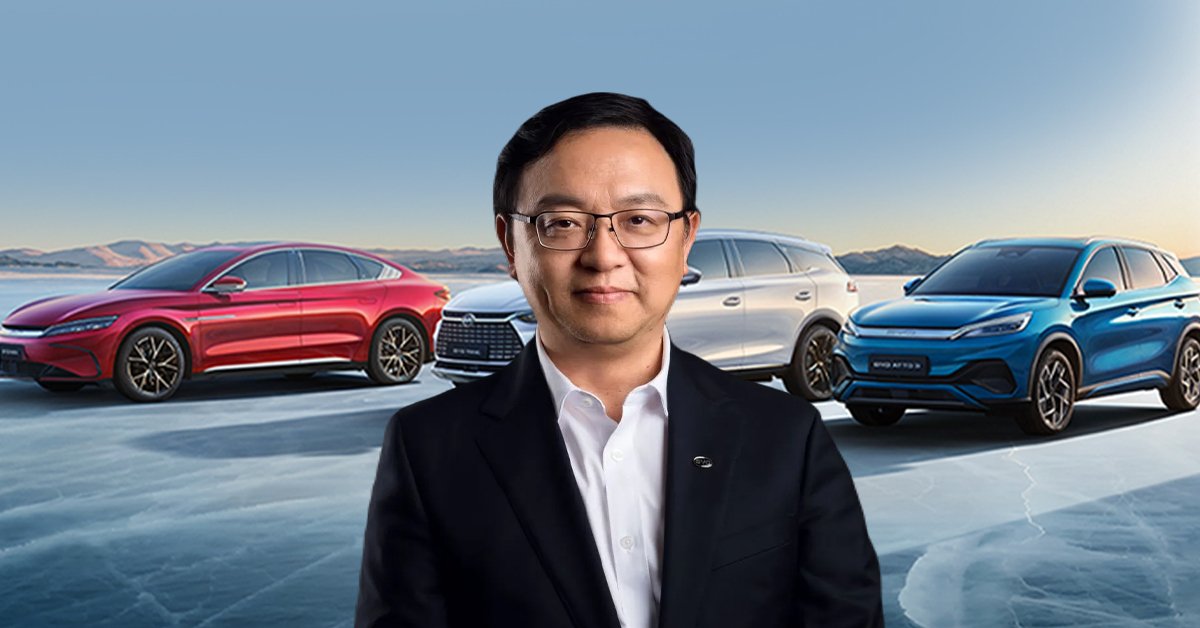
Wang Chuanfu age is currently 59 years old, born on April 8, 1966, in Wuwei County, Anhui Province, China.
As the visionary founder and CEO of BYD Company, he has transformed from an orphaned farm boy into one of the world’s most influential electric vehicle pioneers and billionaire entrepreneurs.
His remarkable journey from poverty to building a global EV empire worth billions showcases extraordinary resilience, innovation, and business acumen that continues to reshape the automotive industry in 2026.
Table of Contents
Quick Facts About Wang Chuanfu
| Attribute | Details |
|---|---|
| Full Name | Wang Chuanfu (王传福) |
| Date of Birth | April 8, 1966 |
| Age | 59 years old (as of 2026) |
| Birthplace | Wuwei County, Anhui Province, China |
| Nationality | Chinese |
| Occupation | Entrepreneur, Chemist, CEO |
| Company | BYD Company Limited (Founder, Chairman, CEO) |
| Net Worth | $24-26 billion USD (2026 estimates) |
| Education | Bachelor’s in Metallurgical Physical Chemistry, Master’s in Materials Science |
| Known For | Building world’s largest electric vehicle manufacturer |
| Marital Status | Married |
| Residence | Shenzhen, China |
Early Life and Background Wang Chuanfu Age
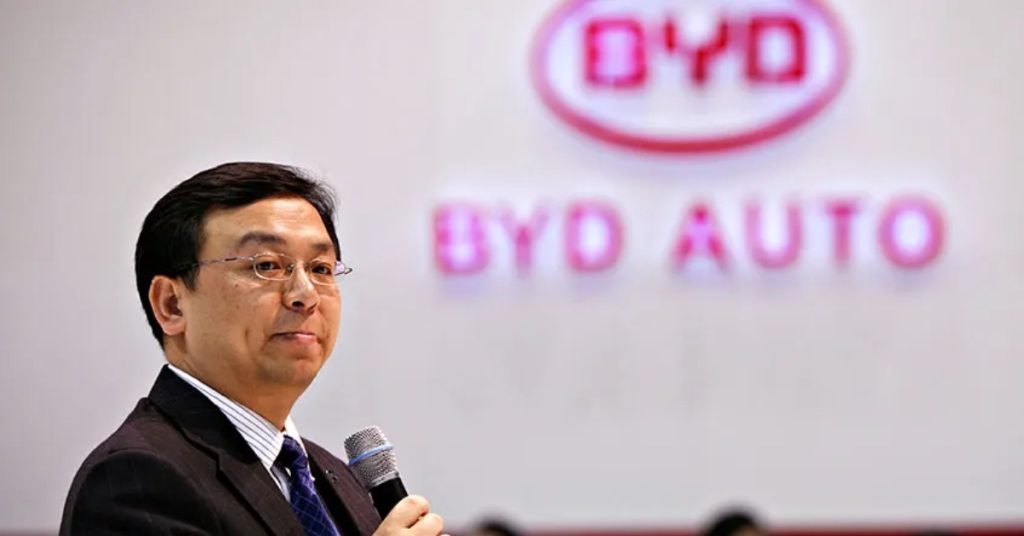
Wang Chuanfu’s story begins in humble circumstances that would shape his relentless drive for success. Born into a poor farming family with eight children, young Wang faced unimaginable hardships early in life.
His father worked tirelessly as a carpenter to support the large family but fell chronically ill. Tragedy struck when Wang was just 13 years old—his father passed away, leaving the family in financial devastation.
Two years later, another catastrophe hit. His mother collapsed while working in the fields and died before receiving medical help. At age 15, Wang became an orphan with an uncertain future.
His elder brother, Wang Chuanfang, made an extraordinary sacrifice. At 18, he dropped out of school to work and support the family. Understanding education’s transformative power, he insisted Wang continue his studies despite their dire poverty.
Wang’s sister-in-law, Zhang Juxiu, became another pillar of support. She sold her dowry jewelry—a woman’s most precious possession—to buy review textbooks when Wang couldn’t afford them for his critical final year of high school.
This family support system became Wang’s foundation. He lived with his brother and sister-in-law during high school, receiving just 10 yuan weekly for expenses while studying at Wuwei Secondary School.
Educational Journey
Despite overwhelming challenges, Wang Chuanfu excelled academically through sheer determination and natural brilliance in science and mathematics.
In 1987, he graduated from Central South Industrial University (now Central South University) with a bachelor’s degree in metallurgical physical chemistry. His brother and sister-in-law moved 750 kilometers to Changsha to stay close and support him during his university years.
Wang earned scholarships year after year, viewing each award as a way to reduce his family’s burden. He later reflected that his motivation for academic excellence stemmed from gratitude toward his brother and sister-in-law.
After completing his undergraduate degree, Wang pursued advanced studies. He earned a master’s degree in materials science from the Beijing General Research Institute of Nonferrous Metals in 1990.
His master’s research focused on “New Inert Anode for the Electrolysis of Al in Molten Salts,” laying crucial groundwork for his future innovations in battery technology and electric vehicles.
The institute recognized his exceptional talent and offered him a position as deputy director immediately after graduation—a prestigious achievement for someone just 24 years old.
Career Beginnings
From 1990 to 1995, Wang worked as a government-sponsored researcher at the Beijing General Research Institute of Nonferrous Metals. This “iron rice bowl” job provided stability and prestige in Chinese society.
In 1993, the institute established BigPower Nickel-Hydrogen Battery Company in partnership with Baosteel Group in Shenzhen. At just 26 years old, Wang was appointed general manager—a testament to his technical expertise and leadership potential.
During this period, Wang gained invaluable experience in battery production, business management, and identifying market opportunities. He observed the mobile phone industry’s explosive growth and recognized the enormous potential in rechargeable battery technology.
In 1994, Wang read that Japanese companies were phasing out nickel-cadmium batteries due to environmental concerns. This shift created a massive market opportunity for alternatives like lithium-ion batteries.
The decision to leave his secure government position wasn’t easy. Wang had recently married, and his wife was pregnant. Stability seemed essential, yet the entrepreneurial opportunity was too compelling to ignore.
After sleepless nights of deliberation, Wang made his choice. At 29 years old in 1995, he resigned from his government position to start his own venture—a decision that would change his life and the global automotive industry.
Founding BYD Company
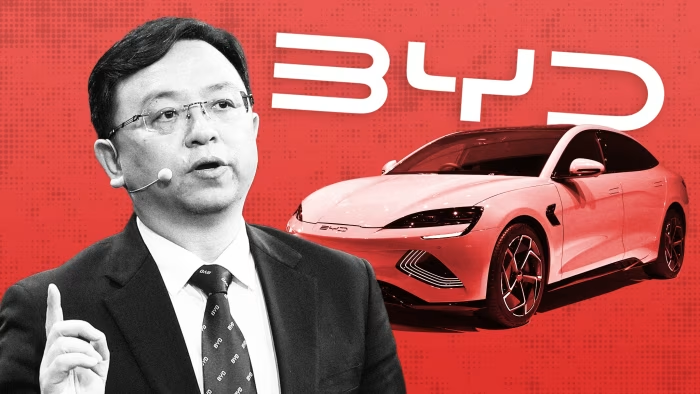
Wang Chuanfu founded BYD Company in 1995 with just $400,000 borrowed from his cousin, Lu Xiangyang, who believed in Wang’s vision and technical brilliance.
The company name “BYD” stands for “Build Your Dreams”—reflecting Wang’s ambitious vision from the outset. He started with just 20 employees in a small factory of approximately 2,000 square meters outside Shenzhen.
Wang implemented an innovative manufacturing approach. While most battery makers relied heavily on expensive automated equipment, he pioneered a hybrid model combining manual labor with selective automation.
This strategy dramatically reduced production costs, allowing BYD to offer competitive prices while maintaining quality. Within three years, BYD became a major player in the rechargeable battery market for mobile phones.
By 1997, BYD was producing lithium-ion batteries for handsets. The company’s growth accelerated rapidly as mobile phone adoption exploded globally during the late 1990s and early 2000s.
In 2002, BYD went public on the Hong Kong Stock Exchange, providing capital for expansion. By 2005, the company held over 50% of the global mobile phone battery market, earning Wang the title “Battery King of China.”
Entry into Automotive Industry
In 2003, Wang made a bold strategic pivot that shocked many industry observers. BYD acquired Qinchuan Automobile Company, a struggling state-owned automaker, for approximately $38 million.
Critics questioned why a battery manufacturer would enter the highly competitive automotive industry. Wang’s vision was clear: electric vehicles would revolutionize transportation, and BYD’s battery expertise provided a unique advantage.
To understand automobile manufacturing, Wang took an unconventional approach. He purchased second-hand vehicles from around the world, disassembled them completely, and studied their design and engineering principles.
Wang stated, “Toyota, being the world’s number one automaker, its craftsmanship, design, and products are worth learning from. Only by standing on its shoulders can we reach new heights.”
BYD launched its first vehicle model in 2005. The company focused initially on hybrid vehicles before committing fully to electric vehicles as its primary strategy.
In 2008, Wang set an ambitious goal: BYD would become China’s leading automotive manufacturer by 2015 and the world’s largest car manufacturer by 2025. His vision was electric vehicles as a “stepping stone” to leapfrog traditional internal combustion engine development.
Warren Buffett’s Investment
In September 2008, a transformative moment arrived for BYD. Warren Buffett’s Berkshire Hathaway, through MidAmerican Energy Holdings, invested $230 million for a 9.89% stake in BYD.
The investment came through Charlie Munger’s recommendation. Munger had been introduced to BYD by Li Lu, founder of Himalaya Capital. After researching Wang and BYD, Munger became convinced of their potential.
Munger spoke admiringly of Wang, calling him “a combination of Thomas Edison and Jack Welch—something like Edison in solving technical problems, and something like Welch in getting done what he needs to do.”
Munger also described Wang as a “genius” and “workaholic” who rose from poverty through hard work and talent. This high-profile endorsement dramatically boosted BYD’s credibility internationally.
By 2009, Wang’s net worth reached $5.1 billion, making him China’s richest man according to the Hurun Report. The Buffett investment had increased BYD’s valuation five-fold within a year.
Berkshire Hathaway’s stake eventually grew to approximately $6 billion by 2021, representing one of Warren Buffett’s most successful investments in recent decades.
Challenges and Recovery
BYD’s journey wasn’t without setbacks. Around 2017-2019, the Chinese government significantly reduced electric vehicle subsidies, severely impacting BYD’s sales volume and profitability.
Net profits declined sharply for three consecutive years. Wang later recalled this as the company’s “darkest moment,” when BYD’s primary goal shifted from growth to mere “survival.”
During this crisis period, Wang demonstrated resilience and strategic adaptability. He focused on technological innovation, particularly developing BYD’s revolutionary “Blade Battery” technology.
The Blade Battery, introduced in 2020, set new industry standards for safety, longevity, and energy density. This innovation became crucial for BYD’s competitive advantage against rivals like Tesla.
BYD also pursued vertical integration aggressively, controlling nearly every aspect of production from raw materials to finished vehicles. This approach reduced costs and maintained quality control.
By 2021, the strategy paid off. BYD’s share price doubled, and Wang’s net worth increased to $23.5 billion, making him the 14th richest person in China according to Forbes.
Rise to Global Dominance
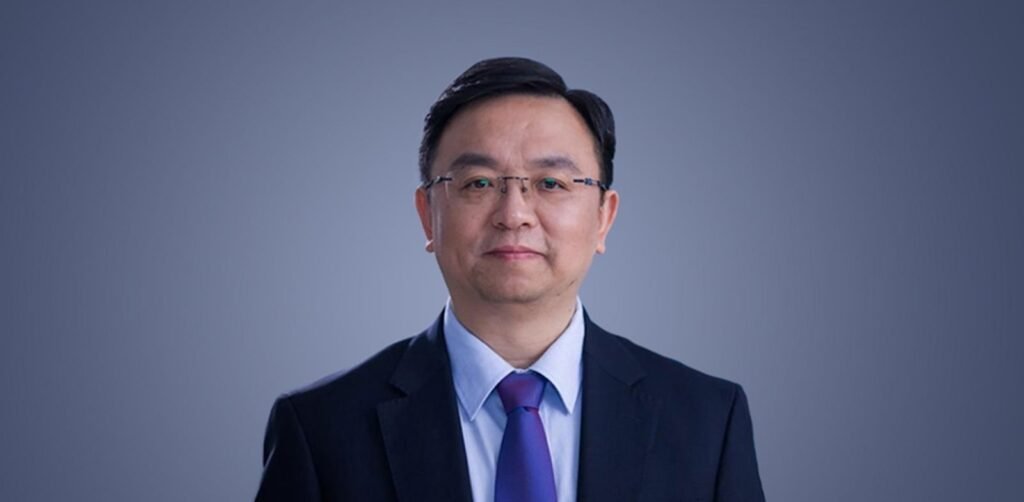
The 2020s marked BYD’s emergence as a global electric vehicle powerhouse. In 2022, BYD surpassed Tesla to become the world’s largest electric vehicle manufacturer by sales volume.
BYD sold over 3 million new energy vehicles in 2023, capturing approximately 21% of the global EV market. By 2024, annual sales reached 4.27 million vehicles with revenue exceeding $107 billion.
The company now holds 32% of China’s new energy vehicle market, far ahead of Tesla’s 6.1% domestic market share in China. BYD employs approximately 969,000 people as of 2024.
BYD’s product line expanded beyond passenger cars to include electric buses, trucks, forklifts, and even electric monorails. The company also produces solar panels and energy storage systems.
In 2024, BYD introduced groundbreaking fast-charging technology capable of adding 250 miles of range in just five minutes—addressing one of the main consumer concerns about electric vehicle adoption.
Wang’s original 2008 goal of becoming the world’s largest car manufacturer by 2025 came remarkably close to fruition, positioning BYD as a true Tesla rival and industry leader.
Net Worth and Financial Standing
As of 2026, Wang Chuanfu’s net worth is estimated between $24-26 billion, primarily derived from his significant stake in BYD Company, where he holds approximately 29% of shares.
His wealth fluctuates with BYD’s stock performance. Bloomberg Billionaires Index ranks him among the top 100 wealthiest people globally and approximately 10th richest in China.
Wang’s net worth increased by $3.37 billion from 2024 to 2025, reflecting BYD’s continued strong performance and market expansion despite intense competition.
BYD’s market capitalization exceeded one trillion yuan (approximately $140 billion) at peak valuations, making it one of the world’s most valuable automotive companies.
Despite his immense wealth, Wang is known for his modest lifestyle. He reportedly still lives in a relatively simple home in Shenzhen, prioritizing proximity to his brother and sister-in-law who supported him during hardship.
Wang rarely makes ostentatious purchases and focuses his resources on BYD’s research and development, continuing to drive innovation in sustainable technology and renewable energy.
Personal Life: Wife and Family
Wang Chuanfu maintains extreme privacy regarding his personal life, keeping family matters largely out of the public spotlight despite his billionaire status and global prominence.
According to various sources, Wang is married to Li Shaohua, whom he reportedly met while both were students at Central South University in Changsha. She has been described as a key figure in his life.
Li Shaohua is believed to have played an important but largely behind-the-scenes role in BYD’s development, particularly in the electric vehicle division, though she avoids public attention.
Wang is believed to have children, with some sources suggesting three children, though their names, ages, and details remain undisclosed. He deliberately keeps his family separate from his public business persona.
His devotion to family extends strongly to his brother Wang Chuanfang and sister-in-law Zhang Juxiu, who sacrificed enormously for his education. Despite his wealth, Wang remains close to them.
Wang renovated his childhood family home and purchased an adjacent property, hoping the family could live together as before. During festivals, he personally cooks meals for his brother and sister-in-law.
Zhang Juxiu once joked that now that Wang was successful, he should earn more money to take them traveling. Wang playfully responded that all his money was earned because of them, and they could go wherever they wished.
There have been unverified allegations about Wang’s personal life, including claims of extramarital relationships. However, these remain unconfirmed and should be viewed with appropriate skepticism absent substantive evidence.
Leadership Style and Philosophy
Wang Chuanfu is renowned for his hands-on leadership approach and deep technical involvement in BYD’s operations, unusual for a CEO of such a large corporation.
Described as a “workaholic” by Charlie Munger, Wang is known for working long hours and maintaining detailed knowledge of BYD’s technological developments and manufacturing processes.
He emphasizes innovation and continuous improvement, encouraging BYD’s engineering teams to push technological boundaries rather than simply following established industry practices.
Wang advocates for vertical integration, believing that controlling the entire supply chain—from raw materials to finished products—provides competitive advantages in quality, cost, and innovation speed.
His leadership philosophy combines technical expertise with pragmatic business strategy. He studies competitors intensively, particularly Toyota, to understand best practices while developing BYD’s unique approaches.
Wang maintains a relatively low public profile compared to other billionaire CEOs. He rarely gives interviews and prefers to let BYD’s products and results speak for themselves.
He is a member of the Chinese Communist Party (CCP). In February 2025, Wang met with CCP General Secretary Xi Jinping at the Great Hall of the People alongside other tech sector leaders.
Hobbies and Personal Interests
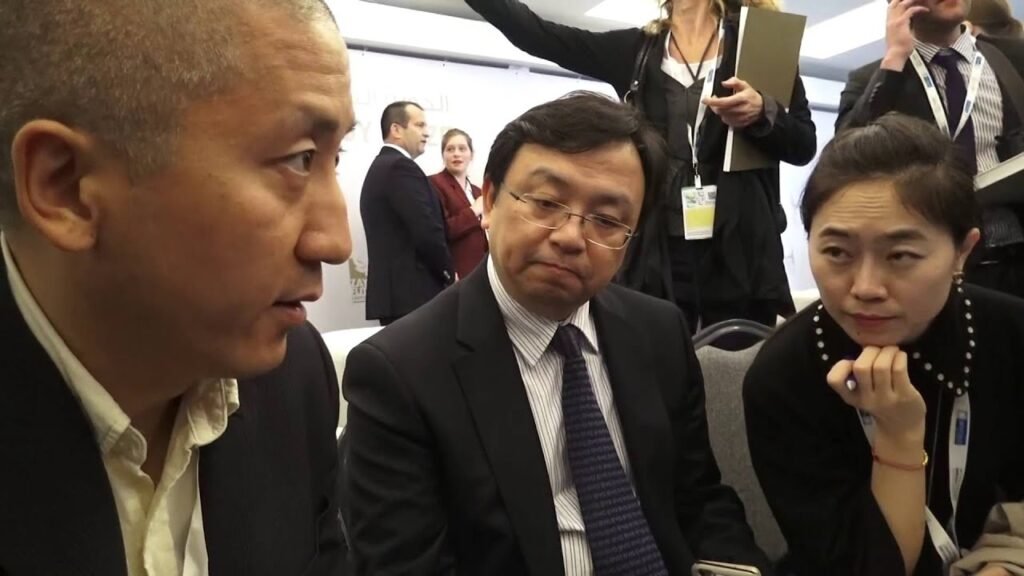
Despite his demanding schedule, Wang Chuanfu cultivates several personal interests that provide balance and creative inspiration outside his business responsibilities.
Wang is a passionate enthusiast of Chinese calligraphy and painting, traditional art forms that require patience, precision, and aesthetic sensibility. These interests reflect his appreciation for Chinese cultural heritage.
He enjoys playing piano, finding music to be a creative outlet that complements his technical and business work. Music provides relaxation and mental refreshment amid intense business demands.
Wang is an avid reader across various subjects, constantly seeking knowledge and new perspectives. His reading extends beyond technical and business topics to include philosophy, history, and literature.
During his university years, Wang was known as the “dance master” at Central South University, actively participating in cafeteria dances—showing a lighter, more social side rarely seen in his public persona.
Wang maintains simple living habits despite his wealth. He’s known for frugality in personal expenses, redirecting resources toward BYD’s innovation and development rather than luxury consumption.
He demonstrates strong philanthropic inclinations, having donated millions to charitable causes, particularly focused on education and environmental conservation—reflecting gratitude for the educational opportunities that transformed his life.
Awards and Recognition
Wang Chuanfu has received numerous accolades recognizing his entrepreneurial achievements, technological innovations, and contributions to sustainable development and electric vehicle advancement.
Forbes, Bloomberg, and Fortune have repeatedly featured Wang in their lists of most influential business leaders and innovators in the automotive and renewable energy sectors.
In 2009, he was named China’s richest man by Hurun Report. He has consistently ranked among China’s top billionaires throughout the 2010s and 2020s.
Industry organizations have honored Wang for pioneering electric vehicle technology and battery innovations that set new standards for performance, safety, and environmental sustainability.
International business publications have compared Wang to iconic innovators like Thomas Edison, Henry Ford, and Elon Musk, recognizing his transformative impact on transportation technology.
Wang’s leadership has been credited with positioning China as the global leader in electric vehicle manufacturing and adoption, contributing to reduced carbon emissions and environmental protection.
BYD’s Global Expansion
Under Wang’s leadership, BYD has aggressively expanded beyond China into international markets across Asia, Europe, North America, and Latin America.
BYD electric buses operate in hundreds of cities worldwide, including London, Los Angeles, Sydney, and São Paulo. The company dominates the global electric bus market with approximately 70% market share.
In Europe, BYD has established manufacturing facilities and partnerships to meet growing demand for electric vehicles while navigating complex regulatory requirements and trade policies.
The company entered the North American market strategically, first establishing credibility through electric buses and commercial vehicles before expanding into passenger cars.
BYD announced plans for manufacturing facilities in multiple countries, including Thailand, Brazil, Hungary, and Indonesia, reducing dependence on Chinese production and mitigating geopolitical risks.
Wang views international expansion as essential for BYD’s long-term competitiveness. He aims to replicate BYD’s Chinese success globally, positioning the company as a truly multinational automotive leader.
Innovation and Technology
Wang Chuanfu’s technical background as a chemist fundamentally shapes BYD’s innovation-driven culture and technological leadership in batteries, electric vehicles, and renewable energy.
BYD’s Blade Battery technology represents a major breakthrough. Using lithium iron phosphate (LFP) chemistry in an innovative structural design, it eliminates thermal runaway risks while improving energy density.
The company pioneered several electric vehicle innovations, including dual-mode hybrid systems, battery swap technology, and advanced battery management systems that extend battery life and performance.
BYD holds an extensive patent portfolio covering electric vehicle technology, battery chemistry and design, energy storage systems, and renewable energy solutions—providing significant competitive advantages.
Wang personally champions research and development investment, dedicating substantial resources to next-generation technologies including solid-state batteries, autonomous driving systems, and vehicle-to-grid integration.
BYD’s vertical integration extends to semiconductor manufacturing. The company produces its own automotive chips through BYD Semiconductor, reducing supply chain vulnerabilities and accelerating innovation cycles.
Philanthropy and Social Responsibility
Despite keeping his charitable activities relatively private, Wang Chuanfu has demonstrated strong commitment to philanthropy and social responsibility throughout his career.
Education remains a primary focus of his philanthropic efforts, reflecting deep gratitude for the educational opportunities that transformed his life from impoverished orphan to billionaire entrepreneur.
Wang has donated millions to educational institutions, particularly supporting students from disadvantaged backgrounds similar to his own circumstances, providing scholarships and resources for promising students facing financial hardships.
Environmental conservation represents another major philanthropic priority. BYD’s core mission of sustainable transportation aligns with Wang’s personal commitment to addressing climate change and environmental degradation.
Wang supports initiatives promoting renewable energy adoption, electric vehicle infrastructure development, and research into sustainable technologies that can reduce environmental impact globally.
He maintains relatively low public profile regarding his charitable work, preferring to make contributions quietly rather than seeking recognition—consistent with his modest personal style.
Legacy and Impact
Wang Chuanfu’s legacy extends far beyond business success to encompass fundamental transformation of global transportation, energy systems, and sustainable technology development.
He demonstrated that electric vehicles could be commercially viable, practical, and desirable for mainstream consumers—not just niche products for environmental enthusiasts or luxury buyers.
BYD’s success proved that Chinese companies could compete with and surpass established Western and Japanese automotive giants through innovation, strategic vision, and execution excellence.
Wang inspired a generation of Chinese entrepreneurs, showing that humble origins need not limit ambitions. His story resonates powerfully in China and globally as testament to education’s transformative power.
Through BYD, Wang has contributed significantly to reducing global carbon emissions. Millions of BYD electric vehicles worldwide replace internal combustion engines, improving air quality and environmental sustainability.
His vertical integration strategy and manufacturing innovations have been studied by business schools and adopted by competitors, influencing how modern automotive companies approach production and supply chains.
Current Status and Future Outlook
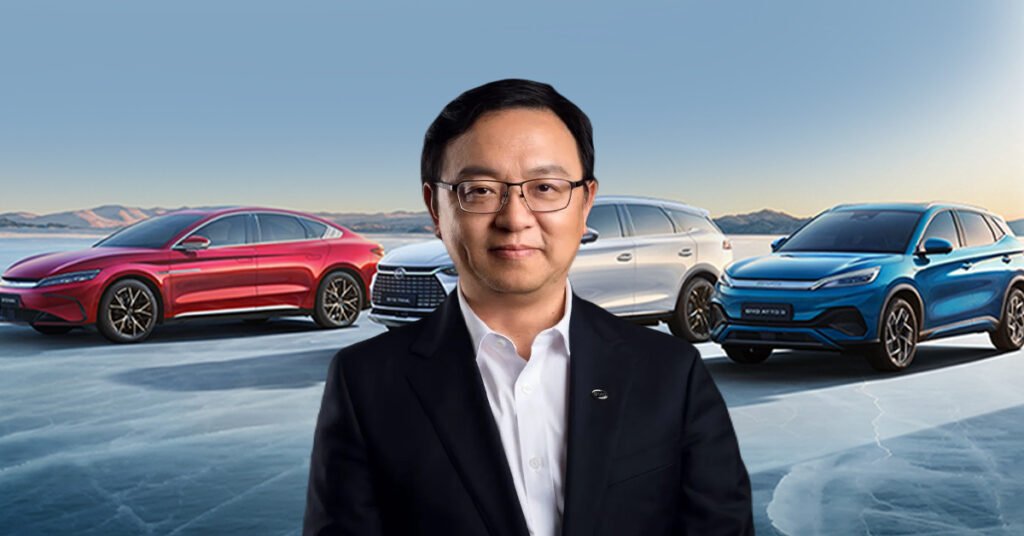
As of 2026, Wang Chuanfu continues serving as chairman and CEO of BYD Company, actively leading the company’s strategy and maintaining hands-on involvement in major decisions.
BYD faces intensifying competition from Tesla, traditional automakers transitioning to electric vehicles, and emerging Chinese EV startups—requiring continued innovation and strategic adaptation.
Wang focuses on expanding BYD’s global footprint while maintaining dominance in China’s massive domestic market. International growth represents critical priority for long-term sustainability and competitiveness.
The company invests heavily in next-generation technologies including autonomous driving systems, advanced battery chemistries, and integrated mobility solutions combining vehicles, energy storage, and renewable energy.
Wang’s vision extends beyond vehicles to comprehensive sustainable energy ecosystems. BYD develops solar panels, energy storage systems, and grid integration technologies supporting the global energy transition.
Industry analysts expect BYD to remain among the world’s leading electric vehicle manufacturers throughout the 2020s, with Wang’s leadership continuing to drive innovation and market expansion.
10 Frequently Asked Questions
What is Wang Chuanfu’s age in 2026?
Wang Chuanfu is 59 years old in 2026, having been born on April 8, 1966, in Wuwei County, Anhui Province, China.
What is Wang Chuanfu’s current net worth?
Wang Chuanfu’s net worth is estimated between $24-26 billion USD as of 2026, primarily from his approximately 29% stake in BYD Company.
Who is Wang Chuanfu’s wife?
Wang Chuanfu is married to Li Shaohua, whom he reportedly met during their university years at Central South University in Changsha, China.
How did Wang Chuanfu start BYD?
Wang founded BYD in 1995 at age 29 with $400,000 borrowed from his cousin Lu Xiangyang, starting with 20 employees manufacturing rechargeable batteries.
Did Warren Buffett invest in Wang Chuanfu’s company?
Yes, Warren Buffett’s Berkshire Hathaway invested $230 million for a 9.89% stake in BYD in September 2008, now worth billions.
Is BYD bigger than Tesla?
Yes, BYD surpassed Tesla in 2022 to become the world’s largest electric vehicle manufacturer by sales volume, selling over 4 million vehicles in 2024.
What education does Wang Chuanfu have?
Wang holds a bachelor’s degree in metallurgical physical chemistry from Central South University (1987) and a master’s in materials science from Beijing General Research Institute (1990).
How many children does Wang Chuanfu have?
Wang is believed to have three children, but he keeps details about them private and out of public attention.
What happened to Wang Chuanfu’s parents?
Wang’s father died when he was 13 years old, and his mother died when he was 15, leaving him orphaned and raised by his elder brother.
Where does Wang Chuanfu live now?
Wang Chuanfu resides in Shenzhen, China, where BYD Company is headquartered, reportedly living modestly near his brother and sister-in-law.
Conclusion
Wang Chuanfu’s journey from orphaned farm boy to billionaire electric vehicle pioneer exemplifies extraordinary resilience, vision, and determination.
At 59 years old in 2026, his impact on global transportation and sustainable technology continues growing as BYD solidifies its position as the world’s largest electric vehicle manufacturer.
With a net worth exceeding $24 billion, Wang remains remarkably grounded, maintaining close family ties and modest lifestyle while leading BYD’s aggressive global expansion.
His story transcends business success to represent the transformative power of education, the importance of family support, and the potential for innovative thinking to address humanity’s greatest challenges.
From borrowing $400,000 to start a battery company to building a trillion-yuan automotive empire that surpassed Tesla, Wang has fundamentally reshaped the automotive industry’s trajectory toward sustainable mobility.